A Little Taller, a Lot Less Graceful
What stilt walking and AcroYoga taught me about friendship, trust, and the joy of looking ridiculous.
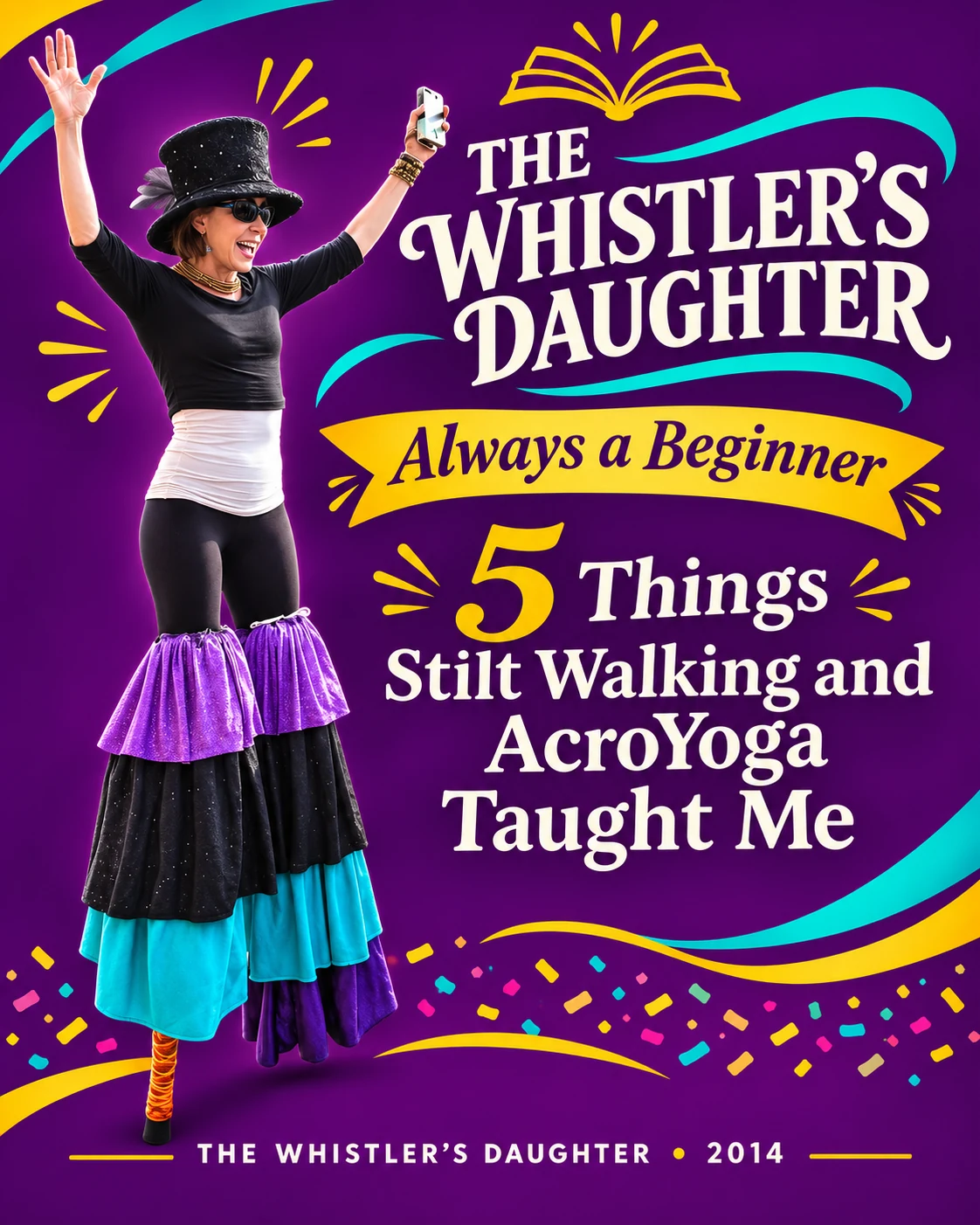
In 1997, I made a promise to myself to learn one new sport every year. By 2014, I'd been at it for seventeen years. I'd climbed mountains, explored caves, surfed waves, and hung upside down from aerial silks.
You might think that after all those adventures, I'd have developed a certain amount of dignity.
Apparently not.
That year, I decided to try stilt walking and AcroYoga. One involved strapping long metal poles to my legs and walking around several feet taller than everyone else. The other involved balancing on someone else's feet while suspended in the air.
What could possibly go wrong?
As it turned out, plenty. But I also discovered something I hadn't expected: these two rather ridiculous activities had a surprising amount to teach me about life.
1. Sometimes a change in perspective changes everything.
My first discovery about walking on stilts was that being tall has some wonderful advantages.
For one thing, I could finally reach the spiderwebs in the corners of my ceiling. No ladder required.
I considered this an excellent return on my investment.
But walking around several feet above everyone else was also a strange experience. Suddenly, I was looking down at people who had always been taller than me. The world looked different. Ordinary surroundings became unfamiliar simply because I was seeing them from another angle.
It reminded me how easily we get stuck in our own perspective.
We become accustomed to seeing ourselves, our abilities, and our limitations in a certain way. Eventually, we stop questioning whether there might be another way to look at things.
Sometimes it takes something as silly as a pair of stilts to shake that up.
And sometimes the best way to see things differently is simply to try something you've never done before.
2. Don't be afraid to stand out.
Once I became reasonably competent on stilts, I started walking in parades with friends.
Now, if you're the type of person who likes to blend into a crowd, I would strongly advise against this activity.
Imagine being several feet taller than everyone else, wearing a ridiculous costume, and walking down a street lined with hundreds of complete strangers.
People point. They cheer. They laugh. They take pictures.
I felt like I'd wandered onto the red carpet, except instead of a designer gown, I was wearing enormous striped pants and trying not to fall on my face.
I must be in hundreds of Instagram posts belonging to people I've never met.
And I loved it.
Somewhere along the way, I stopped thinking about how foolish I might look and started enjoying how much fun everyone was having.
When I was younger, I worried far too much about what people thought of me. I wanted to fit in, look capable, and avoid embarrassing myself.
But there I was, towering over a crowd in a ridiculous outfit, having an absolutely wonderful time.
I wish I'd learned that lesson sooner.
Life gets a lot more interesting when you stop worrying about who's watching.
3. Trust is a wonderful thing. Especially when you're upside down.
AcroYoga introduced an entirely different set of challenges.
Unlike traditional yoga, where you generally have only yourself to blame when you topple over, AcroYoga requires another human being.
One person lies on the ground and uses their feet and hands to support the other, who balances in a variety of positions above them.
The first time I tried it, I was amazed by how much coordination and communication it required.
You can't simply muscle your way through a pose. You have to listen, make adjustments, and trust the person holding you.
Which is easier said than done when your head is pointing toward the floor and your entire body weight is resting on someone's feet.
Sometimes I flew. Sometimes I based. Sometimes I spotted.
And sometimes we all ended up in a heap on the mat.
I was accustomed to sports where my success depended largely on my own effort. If I fell while rock climbing or wiped out surfing, I could usually trace the problem back to something I'd done.
AcroYoga was different.
I couldn't do it alone.
I had to trust someone else, and that person had to trust me.
As someone who has spent much of her life wanting to be in control, this was a useful lesson.
I began to appreciate that relying on someone else wasn't a weakness. It was part of what made the experience possible.
And when we finally managed a difficult pose, the accomplishment belonged to both of us.
4. Perfect moments are wonderful. Imperfect ones make the best stories.
I wish I could tell you that I was a natural at both sports.
I wasn't.
Stilt walking required learning to balance on what felt like two very long, unforgiving toothpicks. AcroYoga demanded strength, flexibility, coordination, and a willingness to put your body in positions it had never considered before.
We made up combinations, crashed into the grass, and laughed ourselves silly.
Sometimes we managed a beautiful pose. Other times we looked like a group of people trying to assemble a piece of furniture without instructions.
But here's what's interesting.
When I think back on that year, I don't remember the perfect performances nearly as vividly as I remember the laughter.
I remember the absurdity of our attempts, the moments when everything went wrong, and the friends who were right there making fools of themselves with me.
I spent years believing that getting better at something was the reward for practicing.
And certainly, improving a skill feels wonderful.
But I was beginning to understand that the process itself could be just as rewarding.
I didn't have to master every sport. I didn't even have to be particularly good.
I just had to enjoy learning it.
That's a rather liberating realization, especially for someone who keeps insisting on trying new things long after most people have settled into activities they're already comfortable doing.
5. Beauty fades, but connection doesn't.
By 2014, I was fifty-four years old.
I'd already been diagnosed with muscular dystrophy, and although I was still physically active, I knew my body wasn't going to remain the same forever.
Neither was anyone else's.
That knowledge had begun to change the way I thought about my adventures.
When I started learning new sports in my thirties, much of the excitement came from discovering what my body could do. Could I climb that mountain? Learn to surf? Run a marathon?
But as the years passed, I began to realize that the people I met along the way were becoming just as important as the sports themselves.
The friends who joined me in parades. The people who supported me in AcroYoga. The laughter afterward when we compared bruises and relived our spectacular failures.
Those relationships were what stayed with me.
I wasn't going to become more beautiful, stronger, or more graceful with age. Quite the opposite, most likely.
But I could continue making friends, sharing experiences, learning things, and finding reasons to laugh.
And that was something my diagnosis couldn't take away from me.
I began to see that the value of these adventures wasn't measured by how well I performed.
It was measured by how much they expanded my world.
Still a beginner
Looking back, I find it amusing that two of the silliest sports I attempted taught me some of the lessons I value most.
Stilt walking reminded me that changing my perspective can change how I see the world.
AcroYoga taught me that trust and cooperation can take me places I couldn't reach alone.
And both reminded me that laughter, friendship, and the willingness to look ridiculous are wonderful ingredients for a happy life.
I still enjoy accomplishing something difficult. I still get a thrill when I finally master a new skill.
But I've also learned not to confuse accomplishment with happiness.
They aren't the same thing.
Some of the happiest moments of my life have happened when I was thoroughly incompetent at whatever I was attempting.
And I suspect there will be plenty more of those moments ahead.
I can't control everything that happens to my body as I age. But I can keep choosing experiences that make my world bigger instead of smaller.
Even if that occasionally means falling flat on my ass.
Christine “Kippy” Hoene is the author of The Whistler's Daughter, a memoir about twenty-eight years of trying new sports, living with muscular dystrophy, and discovering the unexpected rewards of always being a beginner.
Join the conversation
Have a question or a thought about this story? I’d love to hear it.
Loading comments…